About the data
What is the Tax Transparency Code?
The Tax Transparency Code website helps Australians see one simple thing: which large companies earn major income in Australia, and how much company income tax they pay.
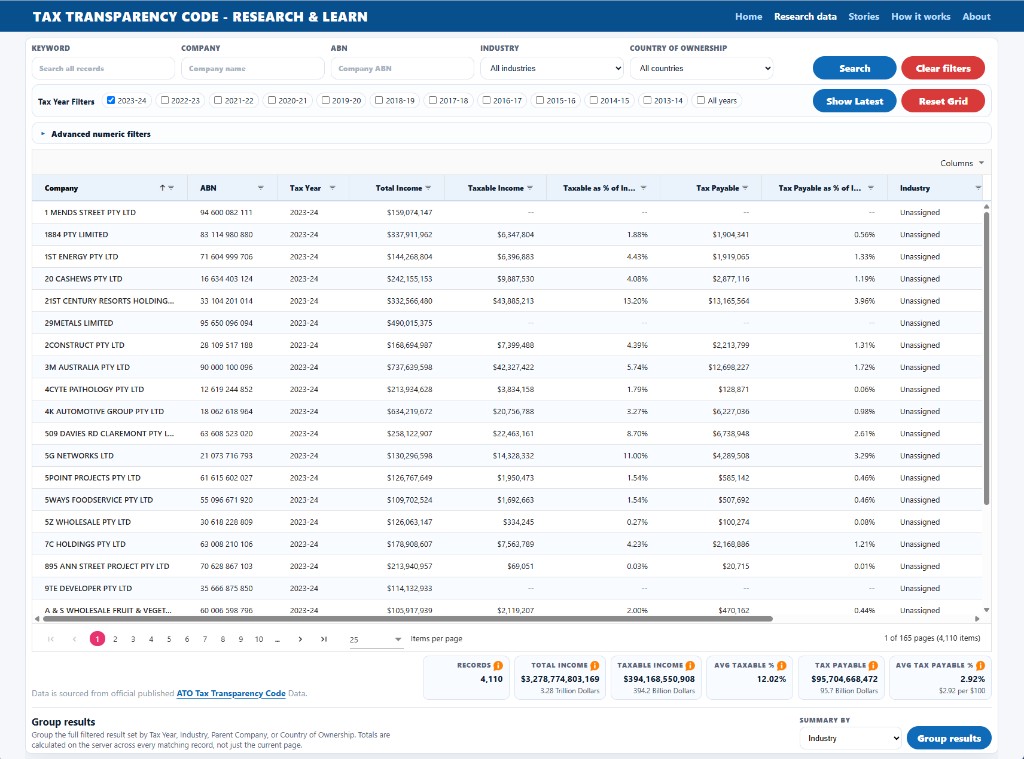
A Public Window into Big Company Tax
The data behind this site comes from public Australian Government tax transparency releases. The core dataset is the ATO's Corporate Tax Transparency Report. That report lists large corporate tax entities and shows four key fields: the entity name, ABN, total income, taxable income, and tax payable.
The first report covered the 2013–14 income year and included more than 1,800 entities. The latest 2023–24 report covers more than 4,100 entities. The ATO says the 2023–24 report includes total income, taxable income and tax payable for those entities.
This website takes that public data and makes it easier to search, sort, compare and understand.
That matters because the raw data is not enough. A spreadsheet can be public and still be hard for ordinary people to use. Public data only becomes public power when people can find it, read it and ask questions.
Two Things Often Get Mixed Together
There are two related ideas.
The first is the Corporate Tax Transparency Report. This is the mandatory ATO data release. It comes from tax law. The law requires the Commissioner of Taxation to publish limited tax information for large corporate tax entities above the reporting threshold. That includes name, ABN, total income, taxable income and tax payable.
The second is the Voluntary Tax Transparency Code. This is a voluntary framework for larger businesses that choose to publish more detail about their tax position, tax strategy and tax governance. The Board of Taxation says the code was designed to encourage better public disclosure and help the community understand how large businesses approach tax.
Our site focuses on the public ATO data. We use “Tax Transparency Code” as the plain public name because that is the idea people care about: tax transparency.
But we are clear about the source.
- This is not leaked data.
- This is not private tax file data.
- This is government-published information.
Why Was Tax Transparency Introduced?
The modern push for corporate tax transparency grew during a period of public anger about large multinationals.
In the early 2010s, Australians saw global companies earning large amounts from Australian customers while booking profits through overseas structures. Google, Apple, Microsoft and other major groups were questioned in the public debate around multinational tax avoidance. In 2015, a Senate inquiry examined whether Australia's tax laws were strong enough and whether more transparency was needed.
The Senate report was bluntly titled You cannot tax what you cannot see. That line captured the issue. If company structures are complex, profits can move across borders. If profits move across borders, the public cannot see the full story.
Australia then took several steps.
The mandatory Corporate Tax Transparency Report gave the public a limited annual view of large company tax outcomes. Later, the government endorsed the Voluntary Tax Transparency Code as part of the 2016–17 Budget. The Board of Taxation says the code was developed after the 2015–16 Budget, with input from Treasury, the ATO, business, professional firms and other stakeholders.
Australia also passed multinational tax measures aimed at large global groups. In December 2015, the government said those measures were designed to make major international companies operating in Australia, but booking profits offshore, pay tax here.
In simple terms, tax transparency was introduced because trust had cracked.
Australians wanted to know whether big companies were paying their fair share.
How Does the ATO Data Work?
The ATO report does not show every business.
It focuses on large corporate tax entities. From the 2022–23 year onward, the reporting population expanded so that corporate tax entities with total income of $100 million or more are generally included. The 2023–24 report included private companies in the $100 million to $200 million range for the second time.
Each row gives a narrow public snapshot.
- Total income
- The total income reported for tax purposes. It is not the same as profit.
- Taxable income
- Income after tax deductions and other tax adjustments.
- Tax payable
- The income tax payable for that year.
A company can show high total income and low or nil tax payable for several reasons. Some reasons may be lawful and normal. A company may have losses from a prior year. It may have large deductions. It may have timing issues. It may be part of a group structure. It may have tax offsets.
So the data does not prove wrongdoing by itself.
But the data does show patterns.
It shows which companies have large Australian income. It shows who reports taxable income. It shows who pays company income tax. It also shows who appears year after year with large income and little or no tax payable.
That is where public scrutiny starts.
What Does the Data Show?
The 2023–24 ATO report covered 4,110 entities. The ATO said 2,974 of those entities paid tax, while 1,136 did not pay tax. That means 28% of the entities in the report had no income tax payable for that year.
The same report showed that large corporate entities paid $95.7 billion in income tax for 2023–24. The ATO described this as the second-highest amount recorded in the history of the report.
Both facts matter.
Some large companies pay huge amounts of tax. They help fund hospitals, roads, defence, aged care, schools and public services.
Others report large income and little or no tax payable.
That gap is the story.
The public has a right to see both sides.
Why Does This Website Exist?
The government publishes the data. But the data is not easy enough to use.
A person should not need to search through ATO download pages, open large CSV files, know which year to choose, clean up columns and build their own tools just to answer a simple question.
The question is simple:
What did this company earn, and what tax did it pay?
That is why this website exists.
We have taken public tax transparency data and made it searchable. We have made it easier to compare companies, find patterns, and see the bigger picture.
This is not about attacking every large business. Some large companies pay enormous amounts of tax. Some also employ thousands of Australians, invest here and build real value.
This is about visibility.
When the public can see the data, people can ask better questions.
- Why do some companies pay tax every year while others do not?
- Why do some industries show repeat nil-tax patterns?
- Why do Australian-owned businesses face constant pressure while offshore-owned groups can move money through complex structures?
- Why does the government keep leaning on workers and local businesses, instead of fixing the gaps that let money leave the country?
Those questions are fair.
What This Site Does Not Claim
This site does not claim that every company with nil tax payable has done something wrong.
This site does not replace the ATO. It does not audit companies. It does not decide guilt.
It does something different.
It gives Australians a clear view of public data that should have been easy to use from the start.
The data belongs in daylight.
When people can see it, they can judge it.
The Next Step
Now you know what the tax transparency data is.
The next question is bigger.
Why did we build this site, and what does the data say about Australia?